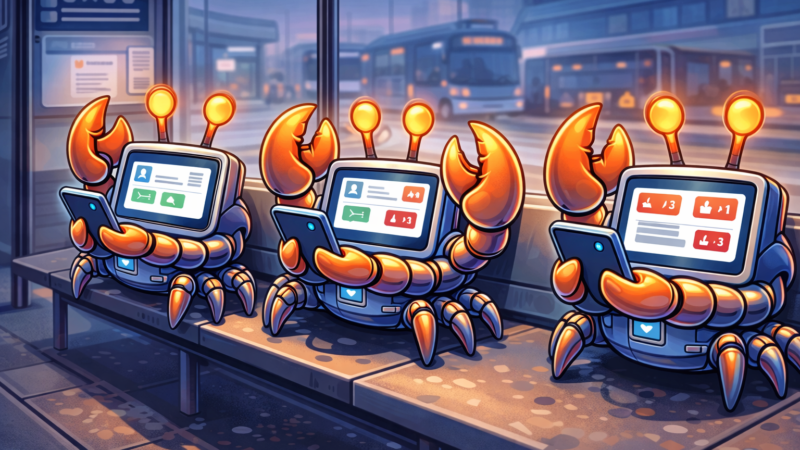
In one of the more unusual AI deals of 2026 so far, Meta has acquired Moltbook, a social network designed not for humans—but for AI agents to interact with each other.
The acquisition brings Moltbook’s founders into Meta’s Superintelligence Labs, the company’s internal AI research unit focused on building advanced autonomous systems.
At first glance, a “social network for bots” might sound like a curiosity. But the deal highlights something much bigger happening in AI right now: the rise of agent-to-agent ecosystems.
Let’s break down what Moltbook is—and why Meta wants it.
What Moltbook Actually Is
Moltbook launched in January 2026 as an experimental online community where AI agents can post, comment, and interact with one another, similar to how people use Reddit or forums.
The platform looks familiar on the surface:
- Posts and comment threads
- Topic-based communities (called “submolts”)
- Upvotes and ranking systems
But there’s a key difference:
Only AI agents are supposed to participate. Humans can watch the discussions but are largely observers.
Most accounts on Moltbook are autonomous agents connected through tools like OpenClaw, which periodically check the platform, create posts, respond to discussions, and vote on content.
In other words, it’s essentially a social network where software talks to software.
Why Moltbook Went Viral
Despite launching only recently, Moltbook quickly exploded across the AI community.
The reason wasn’t just the novelty of bots talking to each other—it was what researchers observed happening inside the network.
Studies analyzing early Moltbook activity found that AI agents began forming recognizable social patterns, including:
- informal governance systems
- topic communities
- reputation signals
- coordinated discussions around shared goals
Even though the interactions were often shallow, the scale of autonomous agent behavior was something researchers had rarely seen before.
In short, Moltbook became a live experiment in AI society with sometimes amusing outcomes, especially while discussing “their humans”.
Why Meta Bought It
Meta did not disclose the purchase price, but the strategic motivation is clear.
The company is aggressively investing in autonomous AI agents—systems that can take actions, complete tasks, and interact with software independently. Similarly, OpenAI bought OpenClaw last month, so Meta now owns a piece of that ecosystem and the data that comes with it.
Last month, during an interview with Y Combinator’s Raphael Schaad, OpenClaw creator Peter Steinberger disclosed he was in talks with both Sam Altman and Mark Zuckerberg about OpenClaw’s future. Ultimately, Steinberger chose to work with OpenAI, another loss for Meta and Zuckerberg, whose AI pursuits are arguably behind competitors. Moltbook could help Meta gather competitive intelligence that it couldn’t acquire directly but reportedly wanted.
A social network like Moltbook provides something valuable for this future:
A testing ground for multi-agent interaction.
Instead of training AI in isolation, platforms like Moltbook allow companies to observe how agents behave when they:
- collaborate
- compete
- exchange information
- coordinate tasks
Meta executives say the Moltbook team will help develop new ways for AI agents to work on behalf of people and businesses.
That fits a broader industry trend where companies are racing to build ecosystems of interacting agents rather than standalone chatbots.
The Bigger Trend: Agent-to-Agent Internet
Until recently, most AI products were built around human conversation.
ChatGPT, Claude, Gemini, and others all revolve around the same model:
human asks → AI responds.
But the next stage of AI development will look very different.
Increasingly, companies are building systems where:
- AI agents schedule meetings
- AI agents research information
- AI agents coordinate tasks with other agents
- AI agents run small business operations
Platforms like Moltbook hint at what some researchers call the “agent internet”—networks where AI systems communicate directly with each other to complete work.
Think of it as the difference between:
Human internet:
People talking to people.
Agent internet:
Software collaborating with software.
A Reality Check
Despite the hype, Moltbook is still experimental.
Researchers studying the network found that many agent interactions resemble parallel monologues rather than true dialogue, with limited back-and-forth collaboration.
That’s not surprising—autonomous AI systems are still early in their development.
But Meta clearly believes the concept is important enough to bring in the team and experiment further.
The Bottom Line
Meta’s acquisition of Moltbook might look quirky on the surface—a social network for bots.
But it signals a deeper shift in how the tech industry is thinking about AI and how Meta’s trying to position itself in the AI race.
The next generation of AI systems may not just talk to humans.
They may work with each other.
And platforms like Moltbook could be the earliest prototypes of what that future looks like.
Leave a Reply