TL;DR
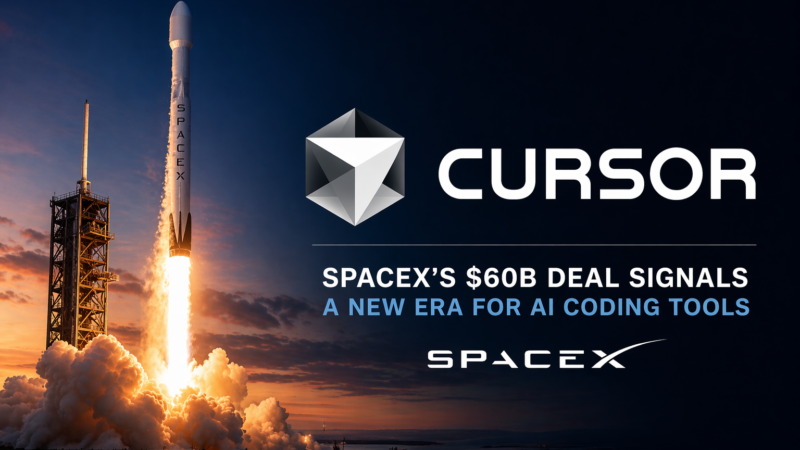
- What happened: SpaceX reportedly struck a deal valuing access to Cursor at up to $60B
- What’s different: This isn’t a typical VC investment—it’s a strategic rights-based deal
- Why it matters: Cursor may be evolving from a developer tool into strategic infrastructure
- Our take: Cursor’s future just got bigger—but also less neutral
The Deal Isn’t Normal—and That’s the Point
According to reporting from major outlets including Yahoo Finance and Business Insider, SpaceX didn’t just “invest” in Cursor in the traditional sense.
They struck a massive, structured deal—reportedly worth up to $60 billion—for rights tied to the platform.
That’s not a passive bet.
That’s strategic positioning.
This kind of deal suggests:
- Deep integration potential
- Long-term influence over how the product evolves
- A belief that AI coding environments will be mission-critical infrastructure
And importantly—it reframes Cursor’s trajectory.
What Cursor Looked Like Before This Deal
Before this move, Cursor’s rise followed a familiar (and impressive) path:
- Fast-growing developer adoption
- Strong product-market fit among power users
- Positioned as a more advanced, flexible alternative to tools like GitHub Copilot
- Built momentum largely on product quality—not enterprise deals
Cursor felt like a developer-first tool.
That distinction matters.
Because developer-first tools tend to:
- Optimize for speed and usability
- Stay relatively neutral across ecosystems
- Move quickly without heavy enterprise constraints
The Hard Truth: That Path Wasn’t Guaranteed to Last
Let’s be honest—without a deal like this, Cursor likely faced a tough road ahead.
AI coding is becoming brutally competitive:
- Microsoft + GitHub Copilot
- Google integrating AI deeply into dev workflows
- Open-source models rapidly improving
- Platform consolidation accelerating
Cursor had momentum—but not inevitability. It needed compute and investment in developing models it owned rather than just relying on Anthropic and OpenAI.
To compete long-term, it needed:
- Capital
- Infrastructure
- Strategic partnerships
- Distribution at scale
This deal solves those problems overnight.
But It Introduces a New One: Alignment
Here’s where this gets more opinionated.
Cursor didn’t just gain resources.
It gained gravity.
When a company like SpaceX enters at this level, the product doesn’t stay purely “developer-first.”
It becomes:
- A strategic asset
- A potential competitive advantage
- A tool shaped by the needs of a very specific, very powerful user
That doesn’t make it bad.
But it does make it less neutral — especially given SpaceX’s ownership. This alignment could be a pro or con depending on your point of view, but for some, it may be a dealbreaker.
What “Less Neutral” Actually Means
This is where developers should pay attention—not panic.
Watch for subtle shifts like:
- Prioritization of enterprise or high-scale use cases
- Optimization for specific engineering environments
- Changes in model access or integrations
- Evolving policies around data, privacy, and training
None of this happens overnight.
But directionally, it matters.
Should You Still Trust Cursor?
For now, yes—with more awareness than before.
Here’s the grounded take:
What hasn’t changed
- Cursor is still one of the most powerful AI coding tools available
- Its core developer experience is still best-in-class
- There’s no immediate reason to abandon it
- You can still use the models you choose
What has changed
- Its incentives may no longer purely aligned with individual developers
- Its future will likely be shaped by high-stakes, large-scale use cases
- It is now part of a much bigger strategic ecosystem – one that ruffles feathers at times
Our Take
If you’re a Cursor user, this isn’t a reason to leave.
It’s a reason to pay closer attention.
Because the version of Cursor that won developers over—fast, flexible, and developer-first—may not be the exact version that exists 12–24 months from now.
Not worse.
But different.
Final Thought
Without this deal, Cursor’s future was uncertain in a crowded, rapidly consolidating market.
With it, Cursor’s future is much more secure—and much more strategic.
And that trade-off is going to define not just Cursor,
but the entire next phase of AI developer tools.
Leave a Reply